Electron Configuration and Orbital Diagrams
Electron configuration shows how electrons fill an atom’s energy levels, sublevels, and orbitals — and why that filling order sets up periodic trends, ions, and bonding, building on atomic structure.
What you'll learn
4.1 Electron Configuration Explained: What It Shows
Every atom has electrons, but they are not arranged randomly. They occupy specific allowed energies, and electron configuration is the shorthand chemists use to show that arrangement.
Here is the story you are about to follow: light shows that atoms have fixed energies, Bohr gives the first energy-level model, the modern model adds shells, sublevels, and orbitals, and then electron configuration becomes a map of where the electrons go.
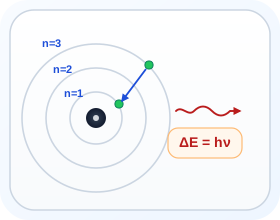
Electrons and energy
Electrons can only have certain allowed energies. They do not slide continuously between values.
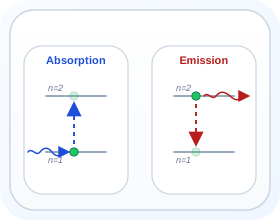
Why light matters
Atoms absorb light to move electrons up and emit light when electrons drop back down. Those jumps reveal the pattern of allowed energies inside the atom.
By the end, a notation like 1s2 2s2 2p4 will mean something physical: which energy levels exist, which sublevels exist inside them, and how many electrons occupy each one.
- Electron configuration is not just a code to memorize. It is a summary of the atom's energy pattern.
- The whole topic starts with light because light is how atoms reveal those energy patterns.
- Do not miss this: if you understand the structure, the notation gets much easier to read.
4.2 Light, Wavelength, Frequency, and Photon Energy
Light is how we know what electrons are doing inside atoms. Understanding wavelength, frequency, and energy is the foundation for understanding Bohr levels and electron configuration. If you are confused here, slow down — the rest of the unit depends on it.
Light travels as a wave and also comes in discrete packets called photons. Two properties describe any light wave:
- Wavelength (λ, lambda) — the distance between two wave peaks, measured in meters (or nm). Longer λ = lower energy.
- Frequency (ν, nu) — how many wave cycles pass a point per second, measured in Hz (s⁻¹). Higher ν = higher energy.
rays
violet
light
waves
waves
Visible light is only a small slice of the full electromagnetic spectrum.
Visible Light, Zoomed In
Approximate wavelength ranges in nmStart with two equations. The first connects wavelength and frequency. The second connects frequency to the energy of one photon.
Rearranged: λ = c / ν and ν = c / λ
The energy of one photon of light is given by Planck's equation:
Combining both equations: E = hc / λ
- Wavelength and frequency always move in opposite directions.
- As wavelength gets longer, frequency gets smaller, and energy gets smaller with it.
- Ultraviolet light (short λ) carries more energy per photon than infrared light (long λ).
- Common mistake: treating wavelength and frequency as if they rise together. They do not.
4.3 Atomic Emission Spectra and the Bohr Model
When a gas is heated or electrically excited, its atoms absorb energy and electrons jump to higher energy levels (excited states). When those electrons fall back to lower levels, they release that energy as light — but only at specific wavelengths. This produces a line emission spectrum, not a continuous rainbow.
Niels Bohr explained this by proposing that electrons can occupy only certain allowed energy levels. In Bohr's model, the number n labels those levels: n = 1, 2, 3, ...
This is the key bridge for the whole unit: the principal quantum number n is the label for the main energy level, also called a shell. So when you hear shell 1, energy level 1, or n = 1, those all refer to the same main level.
Ephoton = |ΔEatom| = hν
For hydrogen specifically, the energy of each level is:
Bohr's model gets us the idea of fixed main energy levels. The modern quantum model keeps those main levels, but adds more detail inside each one: each shell contains smaller energy regions called sublevels.
- The four visible hydrogen lines commonly used in intro chemistry are about 656 nm, 486 nm, 434 nm, and 410 nm.
- Different electron jumps produce different wavelengths because each jump has a different energy gap.
- Important vocabulary bridge: principal quantum number = shell number = main energy level number.
4.4 Energy Levels, Sublevels, and Orbitals
Each main energy level, or shell, contains smaller parts called sublevels. The sublevels are named s, p, d, and f.
Each sublevel contains orbitals, and each orbital can hold up to 2 electrons. Start here with the structure: shell → sublevel → orbital → electrons.
The number of sublevels in a shell equals the value of n. So shell 1 has only one sublevel (1s), shell 2 has two sublevels (2s and 2p), shell 3 has three (3s, 3p, 3d), and so on.
| Sublevel | Number of Orbitals | Max Electrons |
|---|---|---|
| s | 1 | 2 |
| p | 3 | 6 |
| d | 5 | 10 |
| f | 7 | 14 |
That is why a 1-orbital s sublevel holds 2 electrons, while a 3-orbital p sublevel holds 6. A p sublevel has 3 orbitals, so 4 electrons in 2p4 must be spread across 3 boxes.
- The leading number tells you the main energy level, or value of n.
- The letter tells you the sublevel inside that shell.
- The superscript tells you how many electrons are in that sublevel.
- Common mistake: thinking an orbital and a sublevel are the same thing. They are not.
4.5 Shell Capacity vs. Orbital Filling Order
The total number of electrons that fit in each principal shell comes from adding the sublevels inside that shell together:
- n = 1: only s → 2 electrons
- n = 2: s + p → 2 + 6 = 8 electrons
- n = 3: s + p + d → 2 + 6 + 10 = 18 electrons
- n = 4: s + p + d + f → 2 + 6 + 10 + 14 = 32 electrons
Important: these totals tell you the maximum capacity of a shell. They do not tell you which sublevel fills next. Filling order follows sublevel energy, so 4s starts before 3d even though 3d belongs to shell 3.
| Sublevel | # Orbitals | Max electrons | First appears at |
|---|---|---|---|
| s | 1 | 2 | n = 1 (1s) |
| p | 3 | 6 | n = 2 (2p) |
| d | 5 | 10 | n = 3 (3d) |
| f | 7 | 14 | n = 4 (4f) |
- Capacity question: "How many electrons could fit in shell 3?" Answer: 18.
- Filling-order question: "After 3p, what fills next in this course?" Answer: 4s.
- Keep these two ideas separate — they answer different questions.
4.6 The Three Rules: Aufbau, Pauli, and Hund's Rule
Now that you know what each level can hold, here are the three rules for how electrons actually fill those spots.
For neutral atoms in this course, electrons fill the lowest available energy sublevel first. That is why 4s fills before 3d in the configurations you will write here.
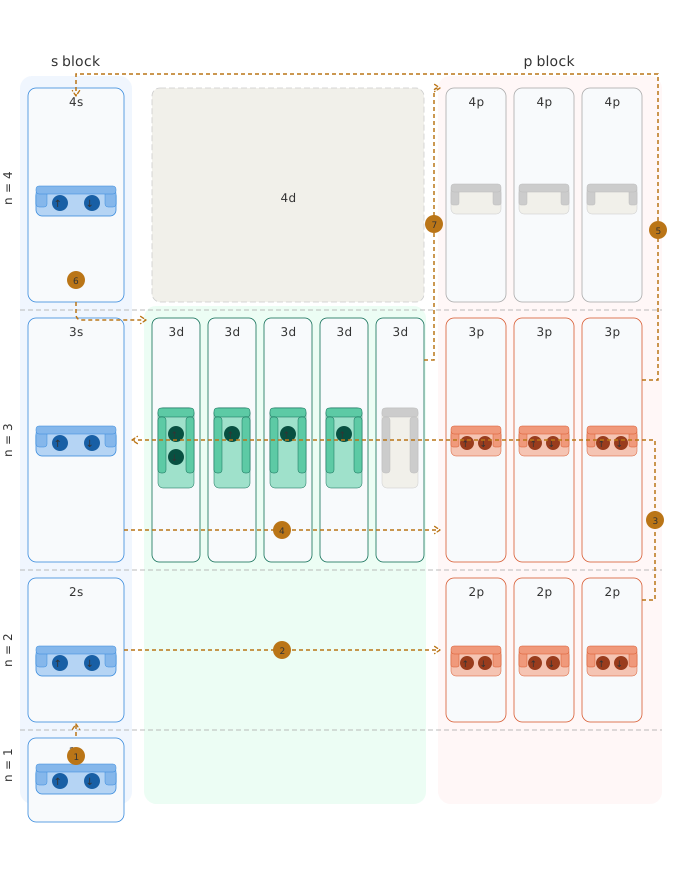
In the diagram, blue cards are s sublevels, green cards are d sublevels, and red cards are p sublevels. The numbered amber arrows show the filling order, and iron ends at 4s2 3d6, so one 3d orbital is paired while four are singly occupied.
Quick Structure Map
- Shell = main energy level.
- Sublevel = s, p, d, or f section inside that shell.
- Orbital = one box that can hold up to 2 electrons.
The Three Rules
- Aufbau: fill the lowest-energy sublevel first.
- Pauli: at most 2 electrons can share one orbital, and they must have opposite spins.
- Hund: in equal-energy orbitals, place one electron in each orbital before pairing.
Each orbital holds a maximum of 2 electrons, and they must have opposite spins (one ↑, one ↓). You cannot place two spin-up electrons in the same orbital.
When filling a sublevel with multiple orbitals (p, d, or f), put one electron in each orbital first (all with the same spin, ↑) before doubling up in any orbital. Electrons prefer to spread out and stay unpaired when they can.
Why? Electrons repel each other. Spreading out into separate orbitals reduces electron-electron repulsion and lowers the atom's energy.
4.7 How to Write Electron Configurations Step by Step
Start with the standard filling pattern. First decide the last-filled sublevel, then write each sublevel in order and count electrons carefully. If you are confused, do not jump straight to shorthand yet.
| Element (Z) | Configuration shown | Noble-gas shorthand |
|---|---|---|
| H (1) | 1s1 | — |
| He (2) | 1s2 | — |
| Li (3) | 1s2 2s1 | [He] 2s1 |
| C (6) | 1s2 2s2 2p2 | [He] 2s2 2p2 |
| Ne (10) | 1s2 2s2 2p6 | — |
| Na (11) | 1s2 2s2 2p6 3s1 | [Ne] 3s1 |
| Ar (18) | 1s2 2s2 2p6 3s2 3p6 | — |
| K (19) | 1s2 2s2 2p6 3s2 3p6 4s1 | [Ar] 4s1 |
| Fe (26) | 1s2 2s2 2p6 3s2 3p6 4s2 3d6 | [Ar] 4s2 3d6 |
After the standard pattern is secure, then learn the common exceptions such as Cr and Cu.
Exception Note
Work through the examples below first. Then read Example 4 for Cr and Cu once the standard pattern feels automatic.
- Noble-gas shorthand replaces the inner electrons with the symbol of the noble gas before your element on the periodic table.
- For example, K (Z=19) is written [Ar] 4s1 because Ar (Z=18) is the noble gas just before K.
- The [Ar] stands for all 18 inner electrons, so you only need to write the outer electrons.
- Common mistake: choosing the next noble gas after the element instead of the one before it.
4.8 Using the Periodic Table to Find Electron Configurations
The periodic table is organized by the sublevel being filled. Each block corresponds directly to a sublevel type. Start here if you tend to freeze on long configurations, because the table gives you the pattern.
Use the table to answer one question first: which sublevel is being filled last? First find the block. Then use the period to choose the number. Click an element to test that one decision in Explore.
- Block tells you which type of sublevel is being filled last.
- Period helps you find the main energy level number.
- For d-block elements, the d sublevel number is usually one less than the period number.
Best way to lock in Unit 04
Once you finish the Unit 04 Practice page, use the larger practice hub for repeated setup work and pair this unit with The Flashcard Method That Works if shells, sublevels, and common ion patterns still need memorization support.
Practice this skill
Try the free electron configuration practice problems with worked solutions.