Atomic Structure: Protons, Neutrons, Electrons, and Atomic Mass
Atomic structure is how protons, neutrons, electrons, isotopes, and ions fit together as one system you can actually use. It builds from matter classification and sets up electron configuration.
What you'll learn
Count protons, neutrons, and electrons from atomic symbols and the periodic table.Predict where average atomic mass should land, then calculate it from isotope abundance data.Determine ion charges and write correct ionic symbols.Read chemical formulas, simplify to an empirical formula, and count atoms when parentheses are used.
3.1 Start Here: How the Atomic Model Changed
Start with the big idea, not the dates: scientists kept changing the atomic model when new evidence forced them to. That pattern matters more than memorizing a timeline by itself.
How Atomic Models Changed
Each new model explained something the older model could not explain well enough.
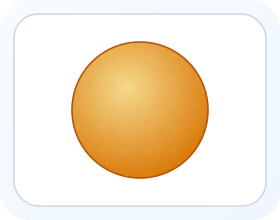
Dalton
1803
Idea: atom = solid, indivisible sphere
Limit: could not explain electrons
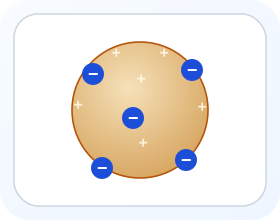
Thomson
1897
Idea: negative electrons embedded in a diffuse positive sphere
Limit: no nucleus and no mostly empty space
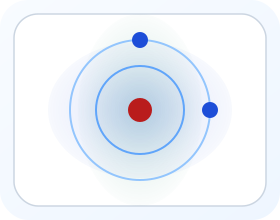
Rutherford
1911
Idea: tiny positive nucleus in mostly empty space
Evidence: gold foil deflections
Bohr to Quantum
1913 and beyond
Bohr: electrons occupy fixed energy levels
Quantum: electrons are described by probability clouds, not exact paths
Big shift: the atom changed from a featureless sphere to a tiny nucleus with electrons arranged by energy and probability.
Each model replaced the one before it when new experimental evidence appeared — the nuclear model you use today came from that sequence.
Here is what Dalton got right — and what the later models kept from his original theory.
Elements are made of tiny, indivisible particles called atoms.
All matter is ultimately composed of atoms, which cannot be created, destroyed, or divided by ordinary chemical means.
In Dalton's model, all atoms of a given element were identical.
Dalton used this idea to explain why each element behaves in its own consistent way. We now know isotopes exist, but the proton count still defines the element.
Compounds form when atoms of different elements combine in fixed, whole-number ratios.
Water is always 2 hydrogen atoms for every 1 oxygen atom — no matter the source. This explains the law of definite proportions.
In chemical reactions, atoms are rearranged — never created or destroyed.
This is the atomic explanation for the law of conservation of mass. The same atoms are present before and after any reaction; they just bond differently.
That fourth point is the one that shows up in every stoichiometry and reaction unit — conservation of mass starts here.
▸
We now know Dalton's theory is not perfectly correct.
Isotopes show that not all atoms of the same element are identical.
Nuclear reactions can also change one atom into another.
For ordinary chemistry, though, Dalton's core idea still works: matter is built from atoms that rearrange in reactions.
3.2 Subatomic Particles: What Scientists Found Inside the Atom
A sequence of experiments in the late 1800s and early 1900s showed that atoms are not indivisible after all. Instead, they contain smaller particles and a tiny dense nucleus. Notice the pattern: each experiment answered a different question about what is inside the atom.
Key experiments that revealed electrons, neutrons, and the nuclear model of the atom, and helped measure particle charge.
Experiment
Scientist
Discovery
Cathode ray tube
J.J. Thomson (1897)
Electrons — small, negatively charged particles in all atoms
Oil drop experiment
R. Millikan (1909)
Measured the fundamental charge of a single electron: −1.602 × 10⁻¹⁹ C
Gold foil experiment
E. Rutherford (1911)
Small, dense, positively charged nucleus at the center; mostly empty space
Nuclear bombardment
J. Chadwick (1932)
Neutrons — neutral particles in the nucleus with mass ≈ proton
Keep the big outcome in view: atoms contain electrons outside the nucleus, while protons and neutrons are in the nucleus. The next section turns that idea into the counting rules you will actually use.
▸
Rutherford's gold foil experiment
Most alpha particles passed straight through, but a few bounced back nearly 180°.
This proved the nuclear model: a tiny dense positive nucleus surrounded by mostly empty space where electrons reside.
The surprise was the rare sharp deflection. If positive charge had been spread out through the atom, the alpha particles would only have drifted slightly. The few strong turns meant nearly all the positive charge was packed into a tiny nucleus.
This close-up connects the nucleus to the electron cloud. The electron cloud occupies most of the atom's volume, so most alpha particles move through that region with little interruption. That cloud is not just empty fuzz: it is organized into distinct energy levels and orbitals that you will study in Unit 04 and apply again in Unit 05. Strong deflection happens only when a particle passes close to the tiny, dense, positively charged nucleus at the center.
Straight through
Most of the atom is empty space.
Slight deflection
Positive charge is concentrated, not spread out.
Rare strong deflection
A tiny dense positive nucleus causes the sharp turn. This is the result that surprised Rutherford most, and it is the one exam questions almost always ask about.
3.3 The Nuclear Atom: Protons, Neutrons, and Electrons
The modern atom has a tiny, dense nucleus containing protons and neutrons, surrounded by electrons in a much larger region of space. Those electrons occupy structured energy levels and orbitals rather than a random blur, and that organization becomes the focus of Unit 04. The nucleus is extremely small compared with the full atom, which is why Rutherford's results mattered so much.
Do not miss this: most of the counting in this unit comes from only four relationships. If you are confused, master those before moving on.
Unit 04 builds directly from this section into how electrons are arranged.
Unit 05 shows how the nucleus and electron arrangement together drive atomic size, ion size, and periodic trends.
Comparison of the three main subatomic particles with their symbols, charges, masses, and locations.
Particle
Symbol
Charge
Mass (amu)
Location
Proton
p+
+1
1.0073
Nucleus
Neutron
n0
0
1.0087
Nucleus
Electron
e-
−1
0.00055
Outside nucleus
Start Here: Key Relationships
Atomic number (Z) = number of protons
Mass number (A) = protons + neutrons
Neutrons = A − Z
Neutral atom: electrons = protons = Z
The one students miss most often: neutrons. You do not read neutrons from the periodic table — you calculate them as A − Z.
3.4 Atomic Number, Mass Number, and Nuclear Symbols
Every element is defined by its atomic number (Z), which is the number of protons. No two elements share the same Z. The mass number (A) is the total count of protons plus neutrons in the nucleus. Keep the jobs separate: Z identifies the element, A identifies the isotope.
We write nuclear symbols in the form:
Nuclear Symbol Notation
AZX, where X = element symbol, A = mass number, and Z = atomic number
Example: 2311Na means sodium with A = 23 and Z = 11, so neutrons = 23 − 11 = 12.
We also write isotopes using a hyphen notation: sodium-23 or Na-23. Both mean the same thing.
▸
The atomic number defines the element.
You can change the number of neutrons (isotopes) or electrons (ions) and still have the same element.
But change the number of protons and you have a completely different element.
3.5 Isotopes and Average Atomic Mass
Isotopes are atoms of the same element with the same number of protons but different numbers of neutrons. That changes the mass number, not the identity of the element. Most elements exist as a mixture of isotopes in nature, which is why periodic-table atomic masses are usually decimals.
Natural isotopes for hydrogen, carbon, and chlorine with their proton, neutron, and abundance data.
Element
Isotope
Protons
Neutrons
Natural Abundance
Hydrogen
H-1 (protium)
1
0
99.985%
Hydrogen
H-2 (deuterium)
1
1
0.015%
Carbon
C-12
6
6
98.93%
Carbon
C-13
6
7
1.07%
Chlorine
Cl-35
17
18
75.77%
Chlorine
Cl-37
17
20
24.23%
Before calculating, make a quick prediction: the average atomic mass must fall between the isotope masses and be closer to the more abundant isotope. This prediction step catches most arithmetic mistakes before they cost you points.
The average atomic mass on the periodic table is a weighted average of all naturally occurring isotopes:
Average Atomic Mass Formula
avg mass = Σ (isotope mass × fractional abundance)
Always convert percent abundance to a decimal before multiplying (75.77% → 0.7577).
Forget this conversion and the answer comes out about 100 times too large.
If your answer is not between the isotope masses, stop. Something went wrong.
3.6 Ions: Atoms with a Charge
A neutral atom has equal numbers of protons and electrons. When electrons are gained or lost, the atom becomes an ion, a charged particle. Start here with the simplest rule: protons stay the same, electrons change.
How gaining or losing electrons changes a neutral atom into a cation or anion.
Change
Result
Charge
Name
Lose electrons
More protons than electrons
Positive
Cation
Gain electrons
More electrons than protons
Negative
Anion
The Electron Count Rule
Electrons = atomic number (Z) − charge
Na+: Z = 11, charge = +1, so electrons = 11 − 1 = 10
Cl-: Z = 17, charge = −1, so electrons = 17 − (−1) = 18
Ca2+: Z = 20, charge = +2, so electrons = 20 − 2 = 18
Notice the sign on Cl-: you are subtracting a negative number, so the electron count goes up, not down. That is where most arithmetic mistakes happen.
▸
Ions still retain the same atomic number and mass number as the neutral atom.
Forming an ion changes the electron count, never the proton count.
Common mistake: subtracting charge from neutrons or changing protons. Do not do that.
3.7 Chemical Formulas: Count Atoms Carefully
Chemical formulas use element symbols and subscripts to represent compounds. Focus on two questions: which atoms are present and how many of each. If you are confused here, fix it now — formula reading shows up again in nomenclature, moles, and stoichiometry.
Two formula views you need most in this unit and what each one shows for glucose.
Formula Type
Shows
Example (glucose)
Molecular formula
Exact number of each atom in one molecule
C6H12O6
Empirical formula
Simplest whole-number ratio of atoms
CH2O
Subscripts apply only to the atom symbol immediately to their left.
Parentheses group a unit — a subscript outside the parentheses multiplies every atom inside.
Counting Atoms in FormulasCa3(PO4)2:
Ca: 3 atoms
P: 1 × 2 = 2 atoms
O: 4 × 2 = 8 atoms
Total = 13 atoms per formula unit
▸
Molecular formula means the full count of atoms in one molecule or formula unit.
Empirical formula means the simplest whole-number ratio.
Always count atoms from the full formula before you simplify to the empirical formula.
3.8 Connecting Atomic Mass to the Mole
One atomic mass unit (amu) is defined as exactly 1/12 the mass of a carbon-12 atom. This bridges atomic and laboratory scales through Avogadro's number. This section is a preview of mole chemistry — the full lesson is in Unit 07.
Key Constants
1 amu = 1.6605 × 10⁻²⁴ g
Avogadro's number: Na = 6.022 × 10²³ particles/mol
Molar mass = atomic/molecular mass expressed in g/mol
If carbon-12 has a mass of 12.000 amu per atom, then 6.022 × 10²³ carbon-12 atoms have a mass of exactly 12.000 grams — this is why atomic mass in amu numerically equals molar mass in g/mol.
When you use molar mass in calculations, the number comes from the periodic table atomic mass. Now you know why.
▸
This connection is the bridge between the microscopic world of individual atoms and the macroscopic world of grams on a balance.
It is why chemists measure in moles, which you will build fully in Unit 07.
Use these like a guided class check. Commit to one answer first, then compare your reasoning. That is the fastest way to fix the usual mistakes with particle counts, isotope averages, and formula reading before you move into electron configuration. For more reps, use the Unit 03 Practice page.
Atom Builder — Choose the Correct Particle Set
Read This First
Use the nuclear notation to choose the correct particle-count set.
Commit to one option before you check.
Decide which set matches the notation shown below.
Given
Loading a nuclear notation prompt...
Choose one complete particle-count set first: protons = Z, neutrons = A − Z, electrons = Z − charge.
▸
Why these counts work
◉
Count rules to remember
Protons always equal the atomic number, Z.
Neutrons come from A − Z.
Neutral atoms have electrons = protons.
Positive charge means electrons were lost; negative charge means electrons were gained.
Average Atomic Mass — Which Estimate Makes Sense?
Read This First
Choose the best estimate before you calculate.
The more common isotope pulls the average toward itself.
Read the isotope masses and abundances below, then commit to the one estimate that makes chemical sense.
Example
Pick an example, choose one estimate, then check your thinking.
▸
Why this estimate makes sense
◉
Average mass reminders
The weighted average must stay between the isotope masses.
The more abundant isotope pulls the average closer to itself.
Percent abundance must be converted to a decimal in the actual calculation step.
Formula Count Check — Choose the Total
Read This First
Choose a compound, then decide the total atom count.
Count atoms from the full formula before you check.
Pay special attention to subscripts and parentheses.
Pick a compound, then decide how many total atoms are in one molecule or formula unit.
▸
How the formula breaks down
◉
Formula counting reminders
Subscripts apply only to the symbol immediately before them unless parentheses group multiple atoms.
An outside subscript multiplies everything inside the parentheses.
Total atom count comes from the full formula, not the empirical formula.
Example 1 · Finding Subatomic Particle Counts
Problem: Determine the particle counts in a neutral isotope.
Given: Iron-56 (Fe-56)
Find: number of protons, neutrons, and electrons in the neutral atom
Step 1 — Start with the particle-count relationships
For any isotope, use these rules first: protons = Z, neutrons = A − Z, and for a neutral atom electrons = Z. For Fe-56, the periodic table gives Z = 26 and the isotope name gives A = 56.
Step 2 — Read the mass number from the isotope name
The "56" in Fe-56 is the mass number A = 56. This means the nucleus contains 56 total nucleons: protons + neutrons.
Step 3 — Calculate neutrons: A − Z
Neutrons = A − Z = 56 − 26 = 30 neutrons
Step 4 — Electrons equal protons in a neutral atom
Neutral atom → electrons = protons = Z = 26 electrons
Problem: Find the electron count for a positive ion.
Given:Ca2+ ion
Find: number of electrons
Step 1 — Start with the ion electron relationship
For an ion, use electrons = Z − charge. Calcium has atomic number Z = 20, so a neutral calcium atom would start with 20 electrons before the charge is applied.
Step 2 — Interpret the ion charge
A 2+ charge means the atom has lost 2 electrons (cation). Each electron lost increases the charge by +1.
Step 3 — Apply the electron formula
Electrons = Z − charge = 20 − 2 = 18 electrons
AnswerCa2+ has 18 electrons (same as argon — an isoelectronic noble gas configuration)
Example 3 · Calculating Average Atomic Mass
Problem: Calculate a weighted average from isotope data.
Given: Chlorine has two stable isotopes: Cl-35 (mass = 34.969 amu, abundance = 75.77%) and Cl-37 (mass = 36.966 amu, abundance = 24.23%)
Find: average atomic mass
Step 1 — Start with the weighted-average relationship
Use average atomic mass = Σ (isotope mass × fractional abundance). Before substituting, predict the result: it must be between 34.969 amu and 36.966 amu, and it should be closer to Cl-35 because Cl-35 is more abundant.
Step 2 — Convert percent abundances to decimals
75.77% → 0.7577 24.23% → 0.2423
Check: 0.7577 + 0.2423 = 1.0000 ✓ (abundances must sum to 1)
Step 3 — Multiply each isotope mass by its fractional abundance
This matches the periodic table value for chlorine: 35.45 amu ✓
Example 4 · Molecular vs. Empirical Formula
Problem: Compare the full molecular formula to the simplest whole-number ratio.
Given: Glucose, C6H12O6
Find: empirical formula and total atom count
Step 1 — Start with the formula relationships
The molecular formula gives the full atom counts, and the empirical formula gives the simplest whole-number ratio. So first read the full subscripts, then reduce them only after the total counts are clear.
Step 2 — Read the subscripts in the molecular formula
Problem: Count atoms when a grouped unit has an outside subscript.
Given:Ca3(PO4)2
Find: number of each type of atom
Step 1 — Start with the grouping rule
In a formula with parentheses, the outside subscript multiplies every atom inside the parentheses. Count any atoms outside the parentheses normally, then multiply the grouped unit.
Step 2 — Count atoms outside parentheses
Ca3: 3 calcium atoms. The subscript 3 applies only to Ca.
Step 3 — Apply the outer subscript to everything inside parentheses