Introductory General Chemistry  ·  Unit 02

Classification of Matter

Start here if “element, compound, or mixture?” still slows you down. This unit teaches you how chemists sort matter, how to read particle diagrams and formulas correctly, and how this connects back to Unit 01 measurement and lab thinking and forward to atomic structure.

What you'll learn

Classify matter as elements, compounds, or mixtures using particle diagrams. Distinguish physical properties from chemical properties, and physical changes from chemical changes. Read chemical formulas, count atoms, and avoid confusing compounds with mixtures. Select the correct separation technique for a given mixture.

2.1 Start Here: What Matter Is and How to Sort It

Matter is anything that has mass and takes up space (volume). All matter is made of tiny particles called atoms. Everything you can see, touch, or weigh is matter: chairs, air, water, and you.

The big skill in this unit is classification. Chemistry gets easier when you stop guessing and start using a decision path. At the top level, matter is either a pure substance or a mixture.

The Classification Roadmap Classification of matter flowchart Matter splits into pure substance and mixture. Pure substance splits into element and compound. Mixture splits into homogeneous and heterogeneous, with inline particle diagrams. Matter Pure Substance Mixture Element Compound Homogeneous Heterogeneous Element One atom type only, even when bonded. Compound Two+ atom types, chemically bonded. Homogeneous Uniform composition throughout. Heterogeneous Visible separate regions or layers.

Pure substances have a fixed composition. Elements contain one type of atom, while compounds contain atoms chemically bonded in a set ratio. Mixtures contain more than one substance without chemical bonding. Homogeneous mixtures look uniform throughout, while heterogeneous mixtures show distinct parts.

  • Use this tree as your roadmap instead of memorizing random examples.
  • Start here: Is it pure or a mixture?
  • If pure, ask whether it is one type of atom only or more than one type chemically bonded.
  • If it is a mixture, ask whether the sample is uniform throughout or split into distinct regions.

2.2 Pure Substances: Elements vs. Compounds

A pure substance has only one type of particle. Every sample has the same composition and the same properties, including a definite melting point and boiling point. Do not miss this: “pure” does not mean “only one element.” A compound can still be a pure substance.

Element
Made from only one type of atom. Cannot be broken down further by chemical processes.
Examples: Au (gold), O₂ (oxygen), Fe (iron), He (helium)
Element Particle Models Au Gold monatomic O O Oxygen (O₂) diatomic element Fe Iron monatomic He Helium noble gas
Compound
Made from two or more types of atoms chemically bonded in a fixed ratio.
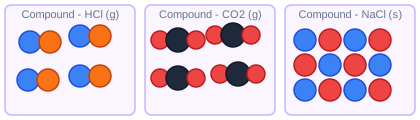
Examples: H₂O (water), NaCl (table salt), CO₂ (carbon dioxide)
Compound Particle Models O H H Water (H₂O) Na⁺ Cl⁻ Table salt (NaCl) O C O Carbon dioxide (CO₂)
  • A compound can only be broken apart by a chemical process, not a physical one.
  • This is different from a mixture, which can be separated physically.
  • Common mistake: seeing two element symbols in one formula and calling it a mixture. If the atoms are chemically bonded in a fixed ratio, it is a compound.

2.3 How to Read Chemical Formulas Without Mixing Them Up

Chemists use formulas to show what a substance is made of. Read the symbols first, then the subscripts. Rush this step and you will confuse compounds with mixtures. More than one element symbol in one formula does not mean mixture.

Capital letters start each element symbol. Symbols are 1 or 2 letters. The first is always capitalized: Na (sodium), Fe (iron), C (carbon).

Subscript numbers show atom count. H₂O = 2 hydrogen + 1 oxygen. H₂O₂ = 2 hydrogen + 2 oxygen. No subscript means exactly 1.

Diatomic elements exist as bonded pairs. H₂, O₂, N₂, F₂, Cl₂, Br₂, I₂ are all elements — every atom is the same type, just bonded.

State symbols go in parentheses. (s) = solid, (l) = liquid, (g) = gas, (aq) = dissolved in water.

  • One repeating chemical formula such as H₂O or CO₂ names a pure substance.
  • A plus sign between substances, such as NaCl + H₂O, shows a mixture of separate substances.
  • If this feels shaky, say the formula out loud in pieces: symbols first, subscripts second, state last.
Anatomy of a Chemical Formula Annotated Chemical Formula Fe₂O₃ (s) Element symbols Fe and O — each starts with a capital letter State of matter (s) solid · (l) liquid (g) gas · (aq) dissolved in water Fe 2 O 3 (s) Subscripts — atom count 2 = two Fe atoms per formula unit 3 = three O atoms per formula unit

Fe₂O₃ (s) = iron(III) oxide, solid state. Two iron atoms and three oxygen atoms chemically bonded → compound.

Practice Reading: H₂O₂ (l) Hydrogen peroxide in the liquid state. Each molecule has 2 hydrogen atoms and 2 oxygen atoms bonded together. Two types of atoms bonded = compound.

2.4 Mixtures: Uniform vs. Non-Uniform Matter

Notice: everything else in this unit is a pure substance. A mixture is what you get when substances are together without actually bonding — each one keeps its own properties and can be pulled back apart physically. The ratio of components can vary. That variable ratio is one of the fastest ways to tell a mixture from a compound.

Homogeneous Mixture (Solution)
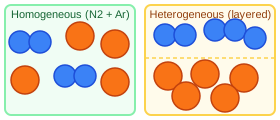
Looks the same throughout. You cannot see individual parts because the substances mix evenly at the particle level.
Examples: salt water, air, steel, orange Gatorade, black coffee, and brass
Heterogeneous Mixture
You can see distinct parts, or the composition differs from region to region.
Examples: salad, sand & water, chocolate chip cookies, granite, and orange juice with pulp
Homogeneous vs Heterogeneous Mixture Particle Diagrams Homogeneous Mixture particles spread evenly throughout Heterogeneous Mixture visible separate regions or layers
  • A solution is another word for a homogeneous mixture.
  • Steel and brass are usually called alloys, which are homogeneous mixtures of metals.
  • Notice that a sample can look like one thing to your eye and still be a mixture at the particle level.

Alloys are a common trap: they look like a pure metal, but they are not. They are homogeneous mixtures at the particle level.

The table below shows four alloys by component and use — all are homogeneous mixtures, not pure elements.

AlloyComponentsCommon Use
BrassCu + ZnMusical instruments, plumbing
BronzeCu + SnStatues, bearings, coins
SteelFe + CConstruction, tools
14k GoldAu ~58% + other metalsJewelry

2.5 Quick Classification Reference You Can Actually Use

Use this when you get stuck on a classification question. Study the "Why?" column — that is the reasoning the test expects you to show.

SubstanceFormulaClassificationWhy?
GoldAuElementOne type of atom
Oxygen gasO₂ElementOnly oxygen atoms (diatomic)
WaterH₂OCompoundH and O chemically bonded
Table saltNaClCompoundNa and Cl chemically bonded
SugarC₁₂H₂₂O₁₁CompoundC, H, O chemically bonded
Salt waterNaCl + H₂OHomogeneous MixtureUniform; NaCl dissolved in water
AirN₂ + O₂ + …Homogeneous MixtureGases evenly mixed
Sand on a beachHeterogeneous MixtureCan see different parts
Orange juice (pulp)Heterogeneous MixturePulp visible; not uniform

2.6 Physical vs. Chemical Properties

Every substance has properties that help identify it. Start with this split: can you observe it without creating a new substance, or does it describe how the substance reacts to form something new?

Physical Properties
Observed or measured without changing the substance into something new.
Examples: color, odor, density, melting point, boiling point, hardness, malleability, ductility, solubility, and state of matter
Chemical Properties
Describe how a substance reacts to form a different substance.
Examples: flammability, reactivity with oxygen (rusting), reactivity with acids or bases, ability to decompose, corrosiveness, and toxicity
Physical vs Chemical Properties Comparison Physical Properties observed without creating a new substance Color and appearance Melting and boiling point Density (mass per volume) Solubility Hardness / malleability State of matter Chemical Properties describe how a substance reacts to form new substances Flammability Reactivity with O₂ (rusting) H⁺ Reactivity with acids/bases ! Corrosiveness and toxicity A Ability to decompose
  • A physical property does not turn the substance into something new. You still have the same substance after you observe or measure it.
  • A chemical property describes what happens when a new substance forms.
  • Common mistake: calling flammability a physical property because you can “see” burning. Burning creates new substances, so it is chemical.

2.7 Physical vs. Chemical Changes: Ask This First

Start with one question: Did a new substance form? If no new substance formed, the change is physical. If a new substance formed, the change is chemical. Common signs such as bubbles or color change are clues, but the rule is still about new substances.

Physical Change
The form, state, or size changes, but no new substance forms.
Examples: melting ice, boiling water, cutting paper, dissolving sugar in water, bending a wire, and evaporation
Chemical Change
At least one new substance forms with different properties.
Examples: burning wood, iron rusting, baking a cake, cooking an egg, silver tarnishing, and baking soda + vinegar
Physical vs Chemical Changes: Before and After Particle Diagrams Physical Change — melting ice Before: H₂O (s) heat After: H₂O (l) Same substance H₂O before = H₂O after Chemical Change — iron rusting Before: Fe + O₂ Fe Fe + O O Fe + O₂ After: Fe₂O₃ (new substance) Fe Fe O O O Fe₂O₃ — iron oxide (rust) New substance formed Fe₂O₃ ≠ Fe or O₂ Different properties → chemical change

Here are the clues you'll see on tests and in labs. Notice which ones are strong clues and which are only hints — that third column is the one worth studying.

Sign of Chemical ChangeExampleWhat It Tells You
Color changeCopper turning green (patina)A clue that often supports new-substance formation
Gas produced (bubbles)Baking soda + vinegar fizzingA strong clue when the gas comes from a reaction
Temperature change (no heating)CaCl₂ + water gets hotA clue that energy changed during a process
Light producedA burning matchA clue that a reaction released energy
Precipitate formsTwo solutions form a solidA strong clue that a new substance formed
IrreversibilityFried egg won't un-fryA clue only; the main test is still new-substance formation

Common trap: dissolving sugar in water

  • The sugar particles spread out in the water, but no new substance forms, so this is a physical change.
  • The sugar can be recovered by evaporating the water.
  • Reversibility is only a clue. The main test is whether a new substance formed.

2.8 Separating Mixtures: Which Method Fits Which Job

Because mixtures are physically combined, they can be separated by physical methods. The method depends on the properties of the substances. Compounds cannot be separated physically; they require a chemical reaction. Do not miss this, because it is one of the cleanest differences between compounds and mixtures.

MethodHow It WorksBest For
FiltrationFilter catches large solids; liquid passes throughSolid + liquid (heterogeneous)
EvaporationHeat drives off liquid; solid left behindDissolved solid in liquid
DistillationDifferences in boiling points separate liquidsTwo liquids with different bp
ChromatographyComponents move at different speeds through a materialIdentifying pigments / inks
MagnetismMagnet pulls out magnetic materialIron in a mixture
CentrifugationSpinning separates by densityParticles suspended in liquid
  • Chromatography can show that black ink is really a mixture of different colored pigments.
  • A sample can look uniform and still be a mixture.
  • If you are stuck on a separation question, ask which physical property is different: particle size, boiling point, density, or magnetism.
✦ Practice Problems
Practice classifying matter now, before atomic structure adds another layer.
✓ 86-problem bank ✓ Thousands of unique review sets ✓ Instant feedback + worked solutions ✓ Best for fixing element/compound/mixture mix-ups early
Start Practicing →
Focused Unit 02 review before Unit 03: Atomic Structure
Introductory General Chemistry · Unit 02 · Classification of Matter