Elements
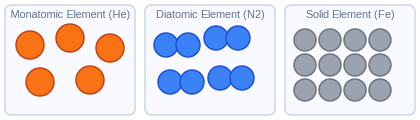
One atom type only. Identical atoms can appear alone or bonded to identical atoms.
Classification of matter starts with the difference between elements, compounds, and mixtures. You’ll sort matter the way chemists do, read particle diagrams and formulas more carefully, connect back to Unit 01 measurement and lab thinking, and get ready for atomic structure.
Use these like a guided class check. Commit to a classification first, then compare your reasoning. That is how you catch the usual mistakes with particle diagrams, formulas, and physical vs. chemical changes before they follow you into atomic structure. For more reps, use the Unit 02 practice sets.
Use this to build the pattern in your head before you try the classifier. Each category shows exactly what to look for before you commit to an answer.
One atom type only. Identical atoms can appear alone or bonded to identical atoms.
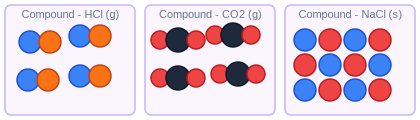
Different atom types are bonded together in the same repeating ratio every time.
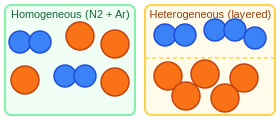
More than one particle type is present. Uniform spread means homogeneous; separate regions mean heterogeneous.
Read This First
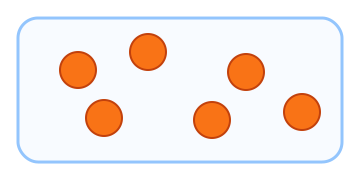
Classify the sample from the particle diagram.
Ask two questions in order: Is there one particle type or more than one? If there is more than one, are the particle types spread evenly or separated into regions?
Scenario: Look at the diagram and choose the best classification.
Why this classification fits
Decision order
Read This First
Decide whether the change is physical or chemical.
Commit to one decision before you see the explanation. Ask one question: did the substance itself stay the same, or did a new substance form?
Scenario: Ice cubes melt into liquid water in a glass.
Reasoning
Common trap to avoid
Problem: Use observations to decide whether each beaker contains a pure substance, a homogeneous mixture, or a heterogeneous mixture.
Given: Beaker A is a clear, uniform liquid that boils sharply at 100°C at 1 atm. Beaker B is a clear liquid with dissolved salt that boils above 100°C at the same pressure. Beaker C contains a white solid floating in a clear liquid.
Find: The best classification for each beaker and the evidence supporting it.
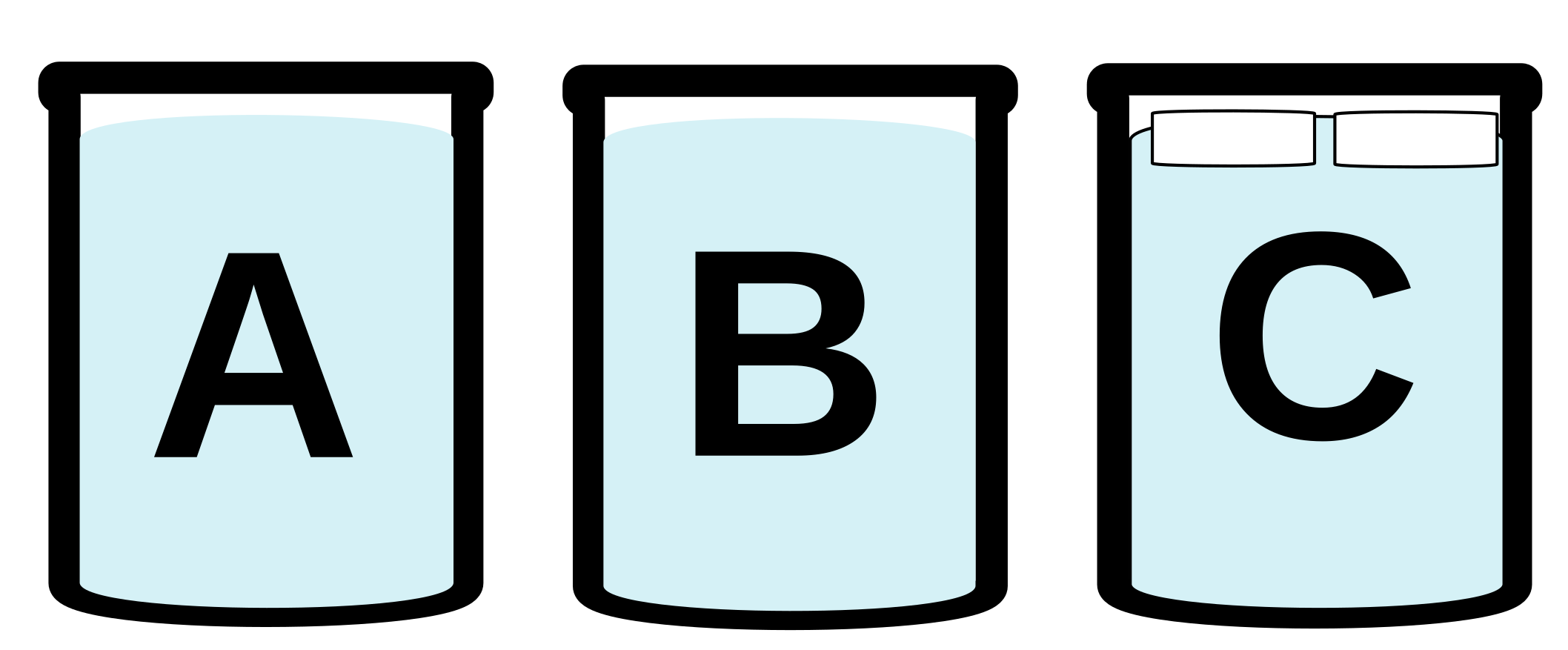
Uniform appearance plus one sharp boiling point indicates a pure substance. At 1 atm, a boiling point of 100°C is consistent with pure water, but the classification step here is simply pure substance.
Looks uniform — you cannot see separate parts — so it cannot be heterogeneous. But the elevated boiling point shows it is not a pure substance. Dissolved salt raises the boiling point above 100°C. Result: homogeneous mixture.
You can see distinct parts — a solid phase and a liquid phase that are not uniformly mixed. The white solid could be undissolved salt, chalk, or any solid that does not dissolve. Visible non-uniform regions = heterogeneous.
Exam shortcut
Problem: Decide whether each change is physical or chemical.
Given: An iron fence rusts, a copper wire is cut, table salt dissolves in water, and baking soda reacts with vinegar.
Find: The type of change in each case and the evidence that supports it.
Iron (Fe) reacts with oxygen and water to form iron oxide (Fe2O3) - a completely new substance with different properties (orange, brittle, flaky). The change is not reversible, and a new substance has formed.
Cutting changes the shape and size, but the copper is still copper — same formula (Cu), same color, same conductivity. No new substance was formed.
The salt seems to disappear, but no chemical reaction occurred. In water, NaCl separates into Na+ and Cl- ions, and the water is still H2O. Evaporate the water and the ions recombine into solid NaCl, so no new substance formed.
The bubbles are CO2 gas produced in a chemical reaction between acetic acid and sodium bicarbonate. New substances form, including carbon dioxide gas, so this is a chemical change. The key rule is still new-substance formation, not just the presence of bubbles.
Problem: Classify the sample shown in the particle diagram.
Given: A closed container with three pairs of touching blue circles, two groups of one large black circle bonded to two small red circles, and several lone orange circles.
Find: Whether the sample is pure or a mixture, and whether the mixture is homogeneous or heterogeneous.
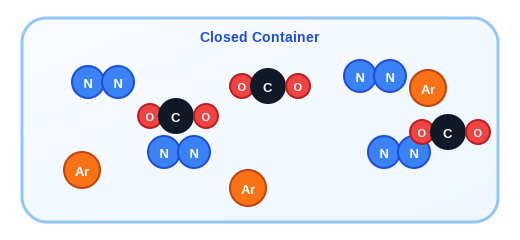
Blue-blue pairs = diatomic element (for example, N2). Red-black-red groups = compound (for example, CO2). Lone orange circles = monatomic element (for example, Ar). Total: 3 different particle types.
There are 3 different types of particles → it is a mixture. A pure substance has only one type of particle.
The particles are described as spread throughout the container without distinct layers or clumps → Homogeneous mixture.
Homogeneous mixture of two elements (N2 and Ar) and one compound (CO2). This is a simplified model of air with a trace noble gas included.
Problem: Read the formula Fe2O3 (s) and classify the substance.
Given: The formula contains Fe, O, subscripts 2 and 3, and the state symbol (s).
Find: The atom counts, the physical state, and whether the substance is an element, compound, or mixture.
Fe is iron and O is oxygen. Because the formula includes two different element symbols, the sample contains two types of atoms.
The subscript 2 means 2 iron atoms. The subscript 3 means 3 oxygen atoms. Subscripts belong only to the symbol directly before them.
The symbol (s) means the substance is in the solid state. State symbols tell you physical state, not classification.
Fe and O are chemically bonded in one repeating ratio, so Fe2O3 is a compound, not a mixture.
Problem: Match each mixture to the physical separation method that works best.
Given: Sand and water, salt water when you want the salt back, and black ink on filter paper.
Find: The best separation method for each mixture and the property that makes that method work.
Sand does not dissolve in water — it forms a heterogeneous mixture. A filter paper will trap the sand particles while water passes through (filtrate). The sand particles are too large to fit through the pores of the filter paper.
The salt is dissolved and cannot be filtered. Heating drives off the water as steam, leaving solid NaCl behind in the evaporating dish. This works because salt does not evaporate at the temperatures used.
The ink is a homogeneous mixture of several colored pigments. Water (mobile phase) travels up the paper (stationary phase) and carries the pigments at different speeds based on their affinity for water. The result is a series of separated color bands.
Practice classifying matter now, before atomic structure adds another layer.
Your first set loads as you scroll here…
What you'll learn
Matter is anything that has mass and takes up space (volume). If you can weigh it or it takes up room, it is matter.
The main job in this unit is classification. Instead of guessing, you want a simple path: first decide whether the sample is a pure substance or a mixture.
Pure substances have a fixed composition. Elements contain one type of atom, while compounds contain different atoms chemically bonded in a set ratio. Mixtures contain more than one substance without chemical bonding. Homogeneous mixtures look uniform throughout, while heterogeneous mixtures have visibly different parts or regions.
A pure substance has only one type of particle. Every sample of it has the same composition and the same properties.
Chemists use formulas to show what a substance is made of. Read carefully — this is where most mix-ups between compounds and mixtures happen.
Capital letters start each element symbol. Symbols are 1 or 2 letters. The first is always capitalized: Na (sodium), Fe (iron), C (carbon).
Subscript numbers show atom count. H2O = 2 hydrogen + 1 oxygen. H2O2 = 2 hydrogen + 2 oxygen. No subscript means exactly 1.
Diatomic elements exist as bonded pairs. H2, O2, N2, F2, Cl2, Br2, I2 are all elements — every atom is the same type, just bonded.
State symbols go in parentheses. (s) = solid, (l) = liquid, (g) = gas, (aq) = dissolved in water.
Fe2O3 (s) = iron(III) oxide, solid state. Two iron atoms and three oxygen atoms chemically bonded → compound.
A mixture is what you get when two or more substances are physically combined without bonding.
Alloys are a common trap — they look like a pure metal but they are not. The table below shows four alloys by component and use. All are homogeneous mixtures, not pure elements.
| Alloy | Components | Common Use |
|---|---|---|
| Brass | Cu+Zn | Musical instruments, plumbing |
| Bronze | Cu+Sn | Statues, bearings, coins |
| Steel | Fe+C | Construction, tools |
| 14k Gold | Au+other metals (about 58% Au) | Jewelry |
Use this when you get stuck on a classification question. Study the "Why?" column — that is the reasoning the test expects you to show.
| Substance | Formula | Classification | Why? |
|---|---|---|---|
| Gold | Au | Element | One type of atom |
| Oxygen gas | O2 | Element | Only oxygen atoms (diatomic) |
| Water | H2O | Compound | H and O chemically bonded |
| Table salt | NaCl | Compound | Na and Cl chemically bonded |
| Sugar | C12H22O11 | Compound | C, H, O chemically bonded |
| Salt water | NaCl+H2O | Homogeneous Mixture | Uniform; NaCl dissolved in water |
| Air | N2+O2+... | Homogeneous Mixture | Gases evenly mixed |
| Sand on a beach | - | Heterogeneous Mixture | Can see different parts |
| Orange juice (pulp) | - | Heterogeneous Mixture | Pulp visible; not uniform |
Every substance has properties that help identify it. Start with this split: can you observe it without creating a new substance, or does it describe how the substance reacts to form something new?
Start with one question: Did a new substance form? If yes, the change is chemical. If no, the change is physical.
Here are the clues you'll see on tests and in labs. Notice which ones are strong clues and which are only hints — that third column is the one worth studying.
| Sign of Chemical Change | Example | What It Tells You |
|---|---|---|
| Color change | Copper turning green (patina) | A clue that often supports new-substance formation |
| Gas produced (bubbles) | Baking soda + vinegar fizzing | A strong clue when the gas comes from a reaction |
| Temperature change (no heating) | CaCl2+water gets hot | A clue that energy changed during a process |
| Light produced | A burning match | A clue that a reaction released energy |
| Precipitate forms | Two solutions form a solid | A strong clue that a new substance formed |
| Irreversibility | Fried egg won't un-fry | A clue only; the main test is still new-substance formation |
Common trap: dissolving sugar in water
Mixtures can be separated by physical methods. The method you choose depends on which physical property differs between the components.
| Method | How It Works | Best For |
|---|---|---|
| Filtration | Filter catches large solids; liquid passes through | Solid + liquid (heterogeneous) |
| Evaporation | Heat drives off liquid; solid left behind | Dissolved solid in liquid |
| Distillation | Differences in boiling points separate liquids | Two liquids with different bp |
| Chromatography | Components move at different speeds through a material | Identifying pigments / inks |
| Magnetism | Magnet pulls out magnetic material | Iron in a mixture |
| Centrifugation | Spinning separates by density | Particles suspended in liquid |
Best way to lock in Unit 02
Once the Unit 02 practice sets feels manageable, use the full practice hub for more reps and pair this unit with The Flashcard Method That Works if element, compound, and mixture vocabulary still blurs together.
Practice this skill
Try the free classifying matter practice problems with worked solutions.