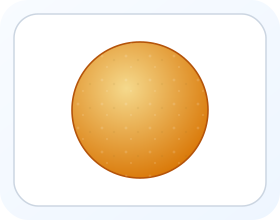
Dalton
1803
Idea: atom = solid, indivisible sphere
Limit: could not explain electrons
Atomic structure is how protons, neutrons, electrons, isotopes, and ions fit together as one system you can actually use. It builds from matter classification and sets up electron configuration.
Use these like a guided class check. Commit to one answer first, then compare your reasoning. That is the fastest way to fix the usual mistakes with particle counts, isotope averages, and formula reading before you move into electron configuration. For more reps, use the Unit 03 practice sets.
Read This First
Use the nuclear notation to choose the correct particle-count set.
Commit to one option before you check.
Decide which set matches the notation shown below.
Why these counts work
Count rules to remember
Read This First
Choose the best estimate before you calculate.
The more common isotope pulls the average toward itself.
Read the isotope masses and abundances below, then commit to the one estimate that makes chemical sense.
Why this estimate makes sense
Average mass reminders
Read This First
Choose a compound, then decide the total atom count.
Count atoms from the full formula before you check.
Pay special attention to subscripts and parentheses.
How the formula breaks down
Formula counting reminders
Problem: Determine the particle counts in a neutral isotope.
Given: Iron-56 (Fe-56)
Find: number of protons, neutrons, and electrons in the neutral atom
For any isotope, use these rules first: protons = Z, neutrons = A − Z, and for a neutral atom electrons = Z. For Fe-56, the periodic table gives Z = 26 and the isotope name gives A = 56.
The "56" in Fe-56 is the mass number A = 56. This means the nucleus contains 56 total nucleons: protons + neutrons.
Neutrons = A − Z = 56 − 26 = 30 neutrons
Neutral atom → electrons = protons = Z = 26 electrons
Problem: Find the electron count for a positive ion.
Given: Ca2+ ion
Find: number of electrons
For an ion, use electrons = Z − charge. Calcium has atomic number Z = 20, so a neutral calcium atom would start with 20 electrons before the charge is applied.
A 2+ charge means the atom has lost 2 electrons (cation). Each electron lost increases the charge by +1.
Electrons = Z − charge = 20 − 2 = 18 electrons
Problem: Calculate a weighted average from isotope data.
Given: Chlorine has two stable isotopes: Cl-35 (mass = 34.969 amu, abundance = 75.77%) and Cl-37 (mass = 36.966 amu, abundance = 24.23%)
Find: average atomic mass
Use average atomic mass = Σ (isotope mass × fractional abundance). Before substituting, predict the result: it must be between 34.969 amu and 36.966 amu, and it should be closer to Cl-35 because Cl-35 is more abundant.
75.77% → 0.7577 24.23% → 0.2423
Check: 0.7577 + 0.2423 = 1.0000 ✓ (abundances must sum to 1)
Cl-35 contribution: 34.969 × 0.7577 = 26.496 amu
Cl-37 contribution: 36.966 × 0.2423 = 8.957 amu
Average atomic mass = 26.496 + 8.957 = 35.453 amu
Problem: Compare the full molecular formula to the simplest whole-number ratio.
Given: Glucose, C6H12O6
Find: empirical formula and total atom count
The molecular formula gives the full atom counts, and the empirical formula gives the simplest whole-number ratio. So first read the full subscripts, then reduce them only after the total counts are clear.
C6H12O6 contains: 6 carbon atoms, 12 hydrogen atoms, 6 oxygen atoms.
Total = 6 + 12 + 6 = 24 atoms per molecule
Subscripts: 6, 12, 6. GCF = 6.
C: 6 ÷ 6 = 1 | H: 12 ÷ 6 = 2 | O: 6 ÷ 6 = 1
Empirical formula: CH2O
Problem: Count atoms when a grouped unit has an outside subscript.
Given: Ca3(PO4)2
Find: number of each type of atom
In a formula with parentheses, the outside subscript multiplies every atom inside the parentheses. Count any atoms outside the parentheses normally, then multiply the grouped unit.
Ca3: 3 calcium atoms. The subscript 3 applies only to Ca.
The subscript 2 outside (PO4) multiplies all atoms inside:
P: 1 × 2 = 2 phosphorus atoms
O: 4 × 2 = 8 oxygen atoms
Ca: 3 + P: 2 + O: 8 = 13 atoms total per formula unit
Practice particle counting and isotope logic now, before electron configuration adds another layer.
Your first set loads as you scroll here…
What you'll learn
Start with the big idea, not the dates: scientists kept changing the atomic model when new evidence forced them to. That pattern matters more than memorizing a timeline by itself.
Each new model explained something the older model could not explain well enough.
1803
Idea: atom = solid, indivisible sphere
Limit: could not explain electrons
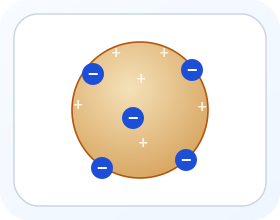
1897
Idea: negative electrons embedded in a diffuse positive sphere
Limit: no nucleus and no mostly empty space

1911
Idea: tiny positive nucleus in mostly empty space
Evidence: gold foil deflections
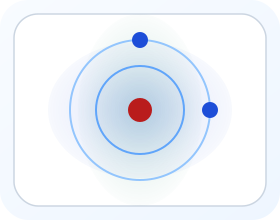
1913 and beyond
Bohr: electrons occupy fixed energy levels
Quantum: electrons are described by probability clouds, not exact paths
Big shift: the atom changed from a featureless sphere to a tiny nucleus with electrons arranged by energy and probability.
Each model replaced the one before it when new experimental evidence appeared — the nuclear model you use today came from that sequence.
Here is what Dalton got right — and what the later models kept from his original theory.
All matter is ultimately composed of atoms, which cannot be created, destroyed, or divided by ordinary chemical means.
Dalton used this idea to explain why each element behaves in its own consistent way. We now know isotopes exist, but the proton count still defines the element.
Water is always 2 hydrogen atoms for every 1 oxygen atom — no matter the source. This explains the law of definite proportions.
This is the atomic explanation for the law of conservation of mass. The same atoms are present before and after any reaction; they just bond differently.
That fourth point is the one that shows up in every stoichiometry and reaction unit — conservation of mass starts here.
A sequence of experiments in the late 1800s and early 1900s showed that atoms are not indivisible after all. Instead, they contain smaller particles and a tiny dense nucleus. Notice the pattern: each experiment answered a different question about what is inside the atom.
| Experiment | Scientist | Discovery |
|---|---|---|
| Cathode ray tube | J.J. Thomson (1897) | Electrons — small, negatively charged particles in all atoms |
| Oil drop experiment | R. Millikan (1909) | Measured the fundamental charge of a single electron: −1.602 × 10⁻¹⁹ C |
| Gold foil experiment | E. Rutherford (1911) | Small, dense, positively charged nucleus at the center; mostly empty space |
| Nuclear bombardment | J. Chadwick (1932) | Neutrons — neutral particles in the nucleus with mass ≈ proton |
Keep the big outcome in view: atoms contain electrons outside the nucleus, while protons and neutrons are in the nucleus. The next section turns that idea into the counting rules you will actually use.
Rutherford's gold foil experiment
Most of the atom is empty space.
Positive charge is concentrated, not spread out.
A tiny dense positive nucleus causes the sharp turn. This is the result that surprised Rutherford most, and it is the one exam questions almost always ask about.
The modern atom has a tiny, dense nucleus containing protons and neutrons, surrounded by electrons in a much larger region of space. Those electrons occupy structured energy levels and orbitals rather than a random blur, and that organization becomes the focus of Unit 04. The nucleus is extremely small compared with the full atom, which is why Rutherford's results mattered so much.
Do not miss this: most of the counting in this unit comes from only four relationships. If you are confused, master those before moving on.
| Particle | Symbol | Charge | Mass (amu) | Location |
|---|---|---|---|---|
| Proton | p+ | +1 | 1.0073 | Nucleus |
| Neutron | n0 | 0 | 1.0087 | Nucleus |
| Electron | e- | −1 | 0.00055 | Outside nucleus |
The one students miss most often: neutrons. You do not read neutrons from the periodic table — you calculate them as A − Z.
Every element is defined by its atomic number (Z), which is the number of protons. No two elements share the same Z. The mass number (A) is the total count of protons plus neutrons in the nucleus. Keep the jobs separate: Z identifies the element, A identifies the isotope.
We write nuclear symbols in the form:
We also write isotopes using a hyphen notation: sodium-23 or Na-23. Both mean the same thing.
Isotopes are atoms of the same element with the same number of protons but different numbers of neutrons. That changes the mass number, not the identity of the element. Most elements exist as a mixture of isotopes in nature, which is why periodic-table atomic masses are usually decimals.
| Element | Isotope | Protons | Neutrons | Natural Abundance |
|---|---|---|---|---|
| Hydrogen | H-1 (protium) | 1 | 0 | 99.985% |
| Hydrogen | H-2 (deuterium) | 1 | 1 | 0.015% |
| Carbon | C-12 | 6 | 6 | 98.93% |
| Carbon | C-13 | 6 | 7 | 1.07% |
| Chlorine | Cl-35 | 17 | 18 | 75.77% |
| Chlorine | Cl-37 | 17 | 20 | 24.23% |
Before calculating, make a quick prediction: the average atomic mass must fall between the isotope masses and be closer to the more abundant isotope. This prediction step catches most arithmetic mistakes before they cost you points.
The average atomic mass on the periodic table is a weighted average of all naturally occurring isotopes:
A neutral atom has equal numbers of protons and electrons. When electrons are gained or lost, the atom becomes an ion, a charged particle. Start here with the simplest rule: protons stay the same, electrons change.
| Change | Result | Charge | Name |
|---|---|---|---|
| Lose electrons | More protons than electrons | Positive | Cation |
| Gain electrons | More electrons than protons | Negative | Anion |
Notice the sign on Cl-: you are subtracting a negative number, so the electron count goes up, not down. That is where most arithmetic mistakes happen.
Chemical formulas use element symbols and subscripts to represent compounds. Focus on two questions: which atoms are present and how many of each. If you are confused here, fix it now — formula reading shows up again in nomenclature, moles, and stoichiometry.
| Formula Type | Shows | Example (glucose) |
|---|---|---|
| Molecular formula | Exact number of each atom in one molecule | C6H12O6 |
| Empirical formula | Simplest whole-number ratio of atoms | CH2O |
One atomic mass unit (amu) is defined as exactly 1/12 the mass of a carbon-12 atom. This bridges atomic and laboratory scales through Avogadro's number. This section is a preview of mole chemistry — the full lesson is in Unit 07.
Best way to lock in Unit 03
After the Unit 03 practice sets, use the full practice hub for mixed retrieval and pair this unit with The Flashcard Method That Works if isotopes, ions, and particle counts still need faster recall.
Practice this skill
Try the free atomic structure practice problems with worked solutions.